
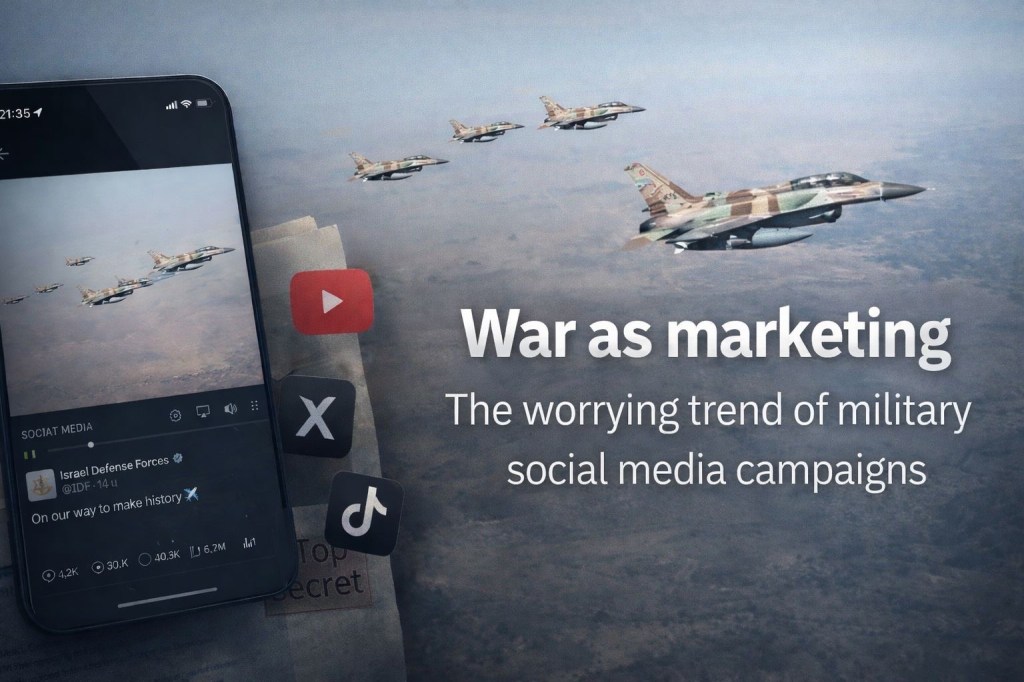
Military operations are increasingly appearing on social media as highly produced videos. Fighter jets flying in formation, dramatic music, fast edits and powerful captions. What once was purely military communication now often resembles marketing.
A recent example is a video posted by the official Israel Defense Forces (IDF) account on X, showing fighter jets in flight with the caption: “On our way to make history ✈️.” The video quickly gained millions of views and tens of thousands of likes.
This kind of content highlights a growing trend: war is increasingly being packaged as social media content.
From military communication to viral content
Traditionally, defense organizations used social media mainly for information sharing: operational updates, official statements or security alerts.
But over the past few years, that approach has changed.
More and more military accounts are publishing content that strongly resembles marketing campaigns:
- Cinematic drone footage of military vehicles
- Montage videos with music and fast cuts
- Heroic captions
- Content optimized for engagement
The style often looks similar to that of sports teams, gaming brands or entertainment companies.
The goal is clear: maximum visibility and influence over the public narrative.
Why militaries are using social media marketing
There are several strategic reasons why military organizations have become more active on platforms like X, Instagram, TikTok and YouTube.
1. Influencing public opinion
In modern conflicts, information plays a crucial role. By publishing compelling videos, militaries can spread their narrative and build support among international audiences.
2. Viral distribution
Social media algorithms reward visual and emotional content. A short video of fighter jets can therefore reach millions of people without relying on traditional media coverage.
3. Direct communication
Military organizations no longer have to communicate through journalists. Social platforms allow them to deliver their message directly to the public.
4. Propaganda in a new form
Propaganda has always been part of warfare, but the format has changed. Where posters and radio were once the primary tools, today they are TikTok videos and X posts.
The concerning trend: war as entertainment
Media and communication experts warn about the consequences of this development.
By presenting war through visually attractive, almost cinematic content, conflict can become romanticized or normalized.
Potential risks include:
- violence being presented as visually appealing
- complex conflicts reduced to short clips
- propaganda becoming harder to recognize
- algorithms amplifying polarizing content
This is especially relevant for younger audiences, who increasingly consume news primarily through social media.
Social media as the new battlefield
Many analysts now speak of an additional dimension of warfare: the digital battlefield.
Alongside land, sea and air, there is now a battle for attention, framing and narrative.
Not only states participate in this space. Militias, activists and civilians also use social media to spread images, stories and propaganda.
Platforms like X and TikTok have therefore become a crucial element of modern geopolitics.
The role of algorithms
One key difference from traditional propaganda is the role of algorithms.
Social media platforms automatically promote content that:
- generates high engagement
- triggers strong emotions
- is visually compelling
Military marketing videos often match these criteria perfectly.
As a result, they can spread faster and further than traditional news reporting.
Conclusion
The video posted by the IDF account illustrates how war and marketing are increasingly converging.
What was once purely military communication is now often strategic social media content designed to go viral.
This raises important questions about propaganda, public opinion and the role of platforms in modern conflicts.
Because in the age of algorithms, battles are fought not only on the battlefield, but also for views, likes and narratives.


 Dossier Mastenbroek
Plaats een reactie